
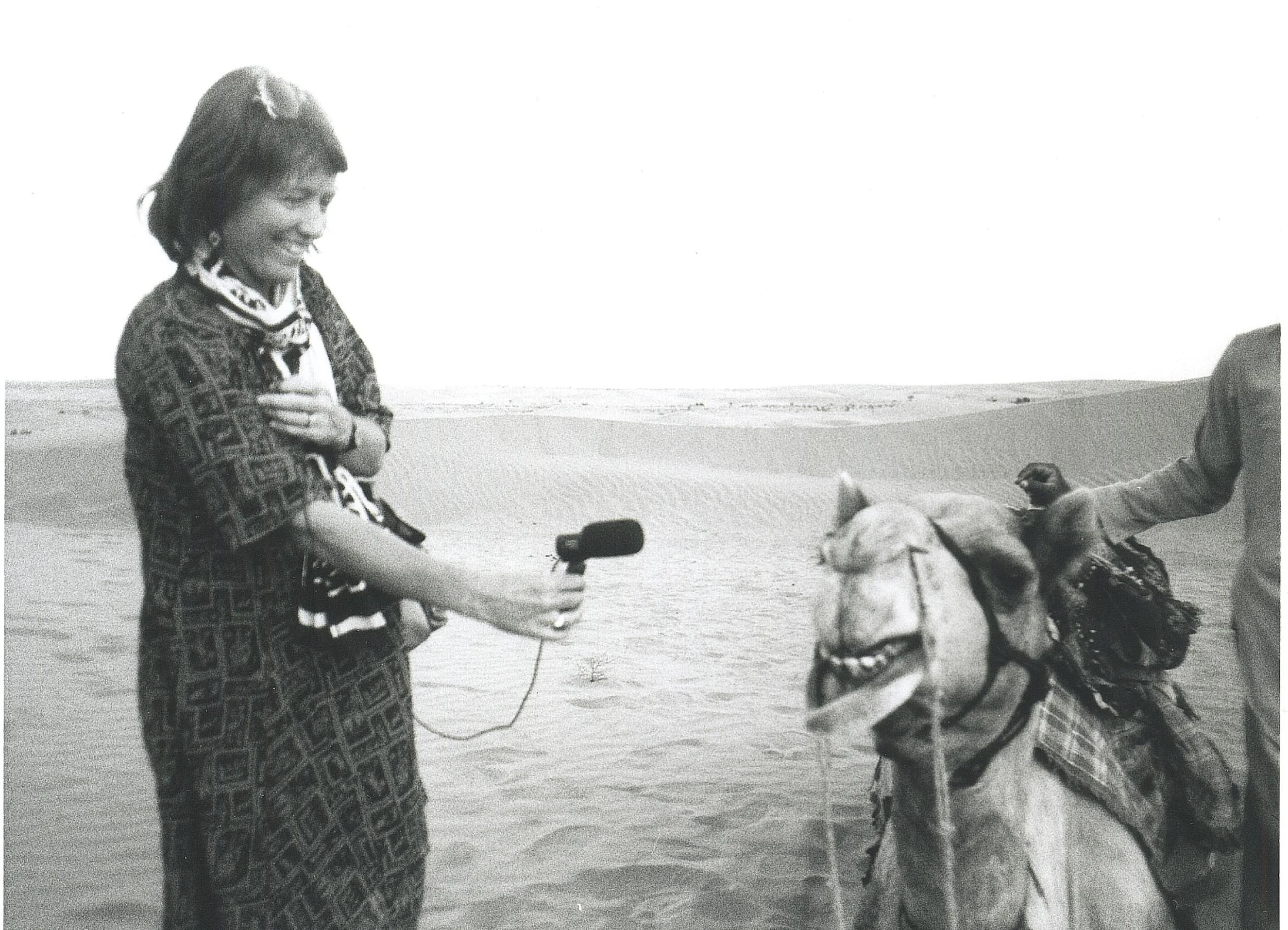
Hildegard Westerkamp recording the sounds of a camel in the desert near Jaisalmer in Rajasthan, India in 1992.
RECORDING & SOUNDSCAPES
“Go out and listen. Choose an acoustic environment which in your opinion sets a good base for your environmental compositions … What kinds of rhythms does it contain, what kinds of pitches, how many continuous sounds, how many and what kinds of discrete sounds, etc. Which sounds can you produce that add to the quality of the environmental music? Create a dialogue and thereby lift the environmental sounds out of their context into the context of your composition, and in turn, make your sounds a natural part of the music around you. Is it possible?”
Hildegard Westerkamp, in “Soundwalking”, Sound Heritage 3(4), 1974: 25).
Part A- Soundwalking
You will explore a sonic environment with a handheld recorder. A soundwalk is a practice that involves listening while moving through space. Your ‘walk’ can take you through any environment that you choose. Consider the contrast between different sounds you capture and consider what you (your body) can add to the soundscape (voice, breath, footsteps, etc.) Try to draw attention to different features of your acoustic environment, and think about presenting an acoustic spatial experience that is layered and engaging (As Oliveros says; “Explore the limits of audibility (highest, lowest, loudest, softest, simplest, most complex, nearest, most distant, longest, shortest sound)”. Think about mixing and layering tracks, and compressing time and space.
Technical Details
After recording you will use Adobe Audition to edit and compile your sounds into a multi-track composition, roughly 60-90 seconds in length. Try to use at least four to six recorded sounds in your final composition. Record your sounds at a 48 kHz sampling rate,16-bit, or 24-bit resolution.
Levels should be recorded between -12 and -6db
Record at least 4 seconds of room tone from every space that you are in
Get in close to some of your sounds
Watch out for handling sounds if you are holding the recorder
Watch out for wind sounds, or air on the mic from moving the recorder- you can make your own windscreen from foam or fake fur
Carry extra AA Batteries
Wear headphones to monitor- your ears pick up sounds differently than microphones
Recording Devices: You will be using a Zoom H1n Portable Recorder with onboard x/y stereo microphones.
Part B Sound Montage- Process/Alter/Experiment
Musique concrète: an experimental technique of musical composition using recorded sounds as raw material. The technique was developed about 1948 by the French composer Pierre Schaeffer and his associates at the Studio d’Essai (“Experimental Studio”) of the French radio system. The fundamental principle of musique concrète lies in the assemblage of various natural sounds recorded on tape (or, originally, on disks) to produce a montage of sound. During the preparation of such a composition, the sounds selected and recorded may be modified in any way desired—played backward, cut short or extended, subjected to echo-chamber effects, varied in pitch and intensity, and so on. The finished composition thus represents the combination of varied auditory experiences into an artistic unity.
For Part B you will make a sonic montage inspired by the techniques of ‘Musique Concrete’. You may layer, process, alter or experiment with any of the sounds you have already recorded from part A. Manipulate sounds by reversing the audio, shifting pitch, looping, panning, reverb, delay, sampling, layering, cutting/pasting, etc. roughly.
*export the file as a.WAV file. Do not submit the multi-track .sesx file